Beneath the Art - In His Image, Though Our Color

Celebrating the beauty and complexity of Black identity through faith and art.

Peace, Chosen — Acrylic on canvas

Peace, ChosenAcrylic on canvas

Shop prints

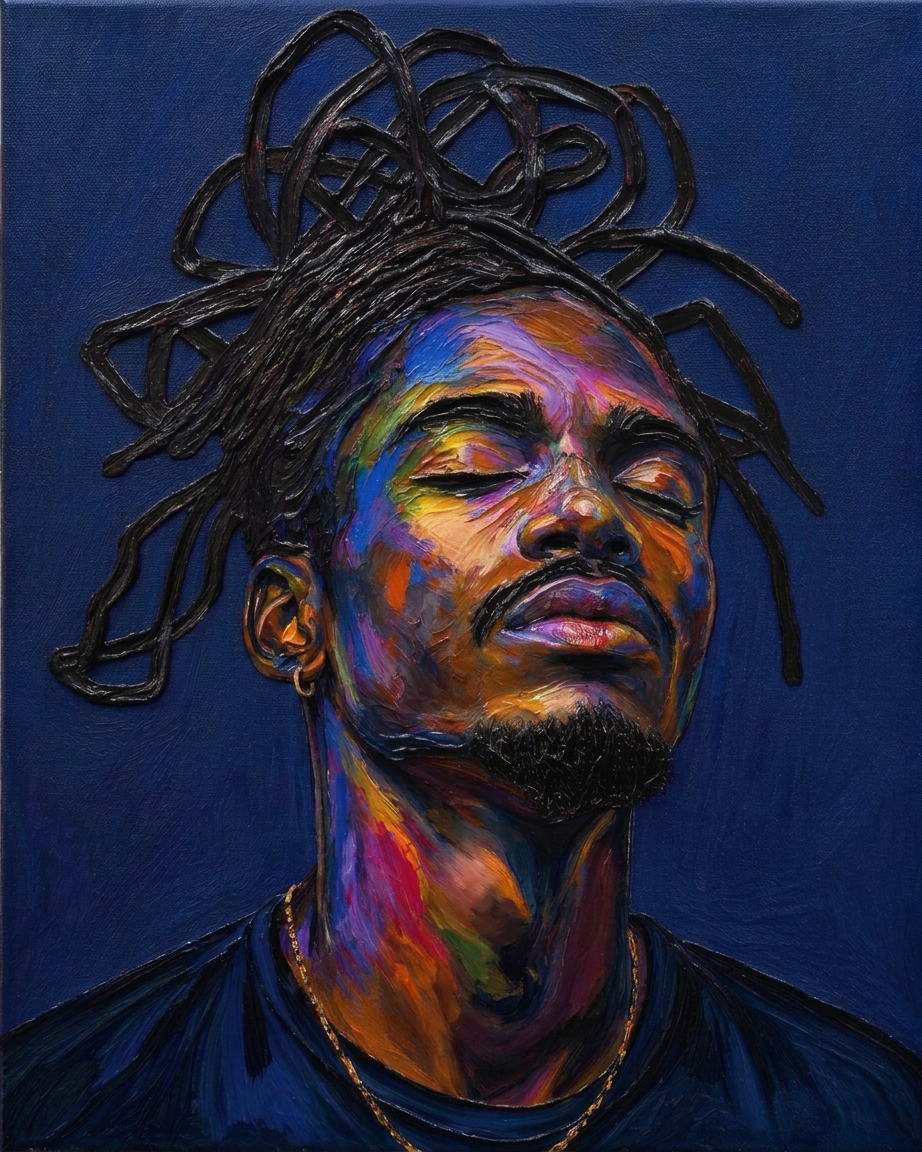
Peace, Chosen

“You will keep in perfect peace those whose minds are steadfast, because they trust in you.” — Isaiah 26:3

Peace does not always come from the absence of noise. Sometimes, it is a decision.

Peace, Chosen captures a moment of intentional stillness — a retreat inward, where solitude becomes sanctuary rather than isolation.

The vibrant layers of color across the subject’s face reflect the complexity of everything he carries: experience, identity, emotion, history, joy, struggle, and becoming. Yet with his eyes closed, he does not appear consumed by those layers. He rests within them.

Around him, movement remains. His locs twist and extend against the deep blue background, creating a sense of energy surrounding a face that has become completely still.

There is something sacred about choosing peace when life gives you every reason not to.

Biblical peace is not dependent upon perfect circumstances. It is the assurance that even in the midst of uncertainty, noise, and struggle, the soul can find a place to rest. The subject’s closed eyes become an act of surrender — a quiet reminder that peace can exist within us before it ever exists around us.

Peace, Chosen honors that sacred decision:

To carry every layer of who you are without being consumed by its weight.

To find solitude without becoming lonely.

To be surrounded by noise without allowing it to become your own.

To trust.

To breathe.

To be still.

To choose peace.
Yet, I Mourn — Acrylic on canvas

Yet, I MournAcrylic on canvas

Shop prints

Yet, I Mourn

“The Lord is close to the brokenhearted and saves those who are crushed in spirit.” — Psalm 34:18

Grief has a language of its own.

Sometimes it cries out. Sometimes it asks questions. And sometimes, it simply closes its eyes and carries what cannot yet be put into words.

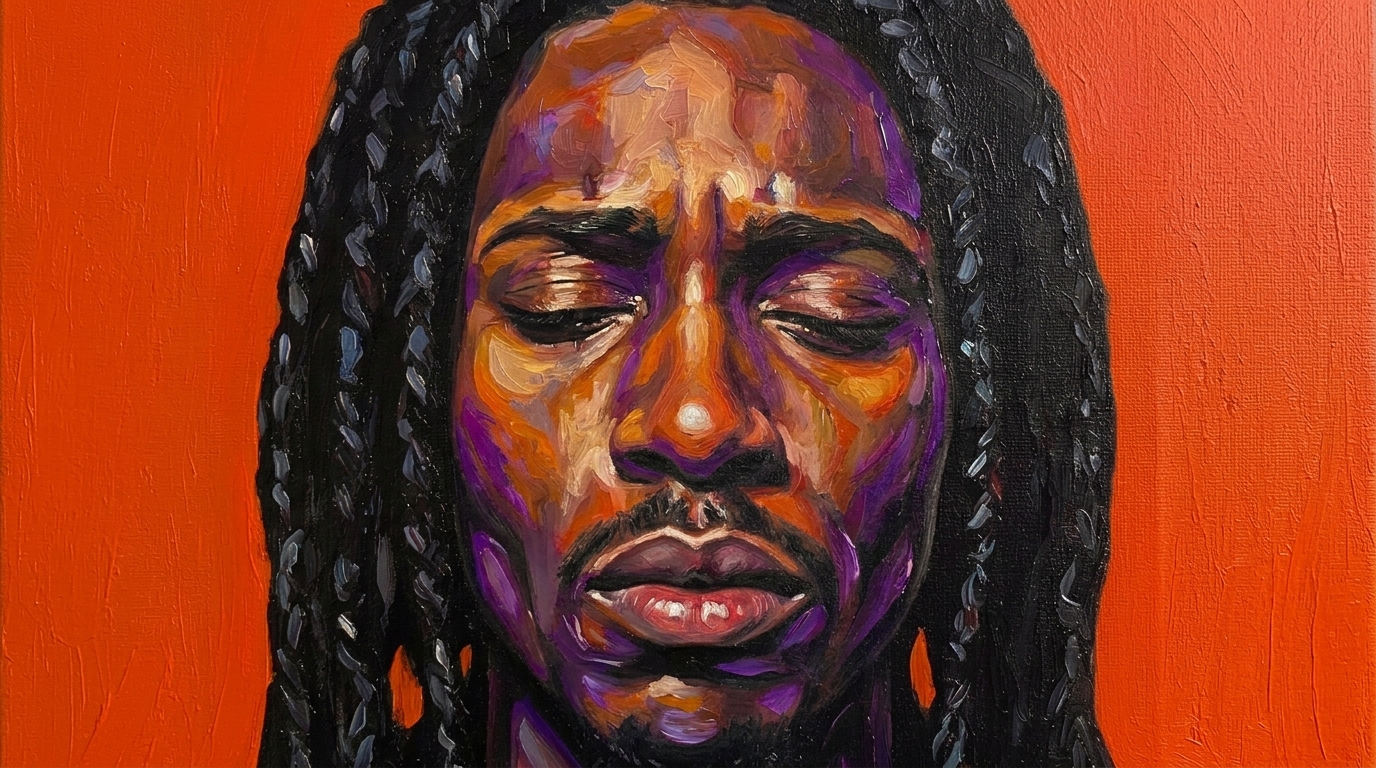
Yet, I Mourn honors the quiet weight of loss — the moments when grief settles beneath the surface and the strongest thing a person can do is allow themselves to feel it.

The layers of orange, violet, gold, brown, and shadow across the subject’s face mirror the complexity of grief itself. There is no single color for sorrow because there is no single way to grieve. Love, anger, memory, confusion, longing, gratitude, and pain can occupy the same heart at once.

The fiery orange surrounding him contrasts with his inward stillness. Life continues around him, vivid and relentless, while he is given permission to remain with what has been lost.

And still, he is not alone.

Psalm 34:18 reminds us that God does not require us to escape our brokenness before drawing near. He meets us there — in the ache, in the questions, in the memories, and even in the silence.

Yet, I Mourn makes room for a truth we are sometimes reluctant to admit:

I can be strong and still grieve.

I can have faith and still hurt.

I can trust God and still have questions.

I can carry hope and still miss what I have lost.

Grief is not the opposite of strength.

Sometimes, grief is simply evidence that something — or someone — was deeply loved.

More Than You See — Acrylic on canvas

More Than You SeeAcrylic on canvas

Shop prints

More Than You See

“People look at the outward appearance, but the Lord looks at the heart.” — 1 Samuel 16:7

You see me.

But do you see all of me?

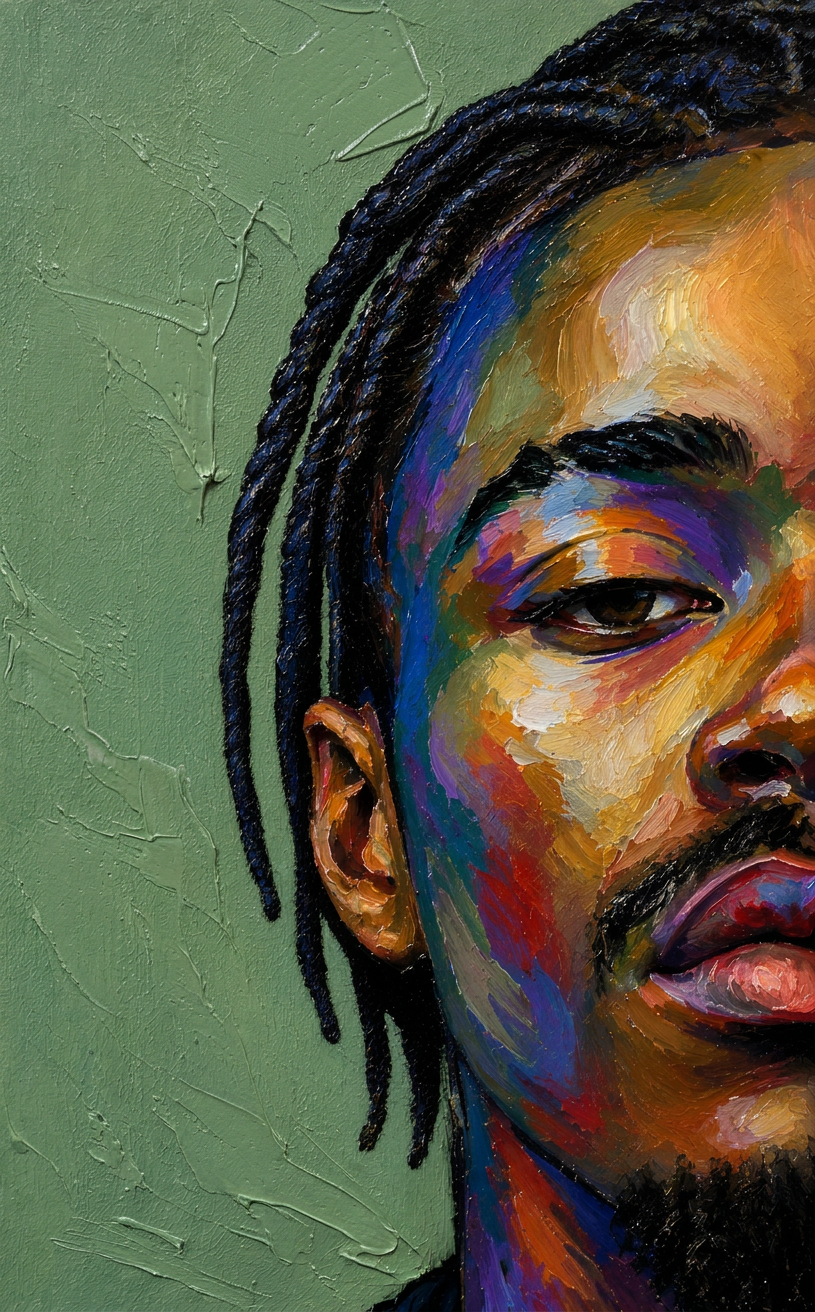
More Than You See explores the tension between visibility and understanding — particularly the experience of the Black man in a world that can be quick to observe him, define him, categorize him, or fear him before ever knowing him.

Only part of the subject is revealed. One eye meets the viewer while the rest of him extends beyond the canvas, intentionally unfinished within our field of vision.

And that is the point.

What is visible is not all that exists.

The layers of color across his face represent everything that cannot be understood through appearance alone: his history, tenderness, strength, fears, faith, dreams, responsibilities, contradictions, wounds, joy, and becoming.

He is not one color.

He is not one emotion.

He is not one experience.

He is not the assumptions placed upon him.

The muted green surrounding him creates space for the vibrancy of his identity to emerge, while the texture reminds us that neither people nor their stories are meant to be experienced as flat.

Scripture reminds us in 1 Samuel 16:7 that humanity often stops at what the eye can perceive, while God sees deeper. He sees the heart. He sees the story behind the expression. He sees the person beyond the perception.

More Than You See asks the viewer to do something similar.

Look again.

Beyond the color of my skin.

Beyond what you have heard.

Beyond what you assume.

Beyond the portion of me you have been allowed to see.

There is more to my story.

All That I Am — Acrylic on canvas

All That I AmAcrylic on canvas

Shop prints

All That I Am

“I praise you because I am fearfully and wonderfully made.” — Psalm 139:14

There is freedom in no longer needing permission to be who God created you to be.

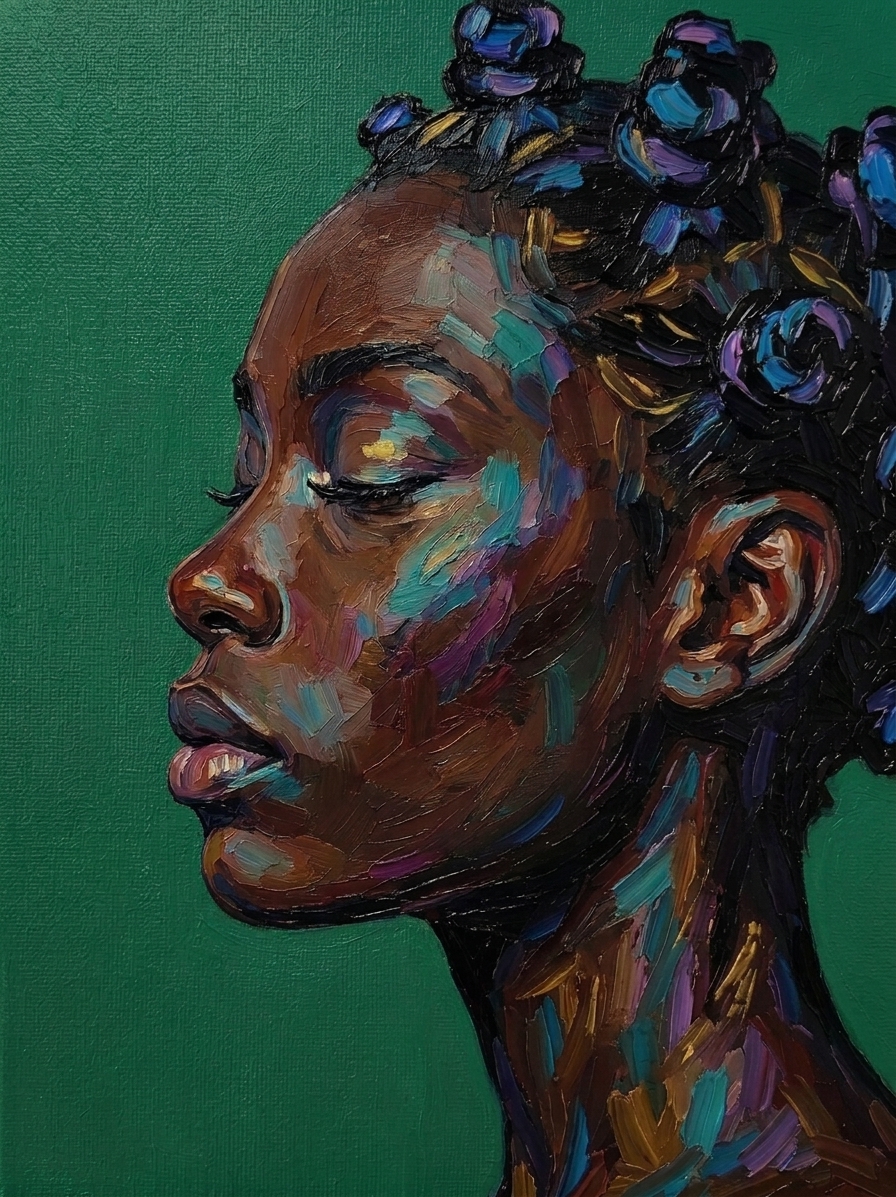
All That I Am is a portrait of Black womanhood at rest within itself — layered, evolving, beautiful, and whole.

With her eyes closed and her face gently lifted, she is not looking outward for affirmation. There is no audience she needs to convince. No expectation she needs to satisfy. No version of herself she needs to perform.

She simply is.

The colors layered across her skin tell a story deeper than what can be seen at first glance. Shades of turquoise, violet, gold, brown, and blue move across her face and neck, representing the experiences that have shaped her — the joy and pain, softness and strength, faith and uncertainty, history and hope she carries within her.

Her complexion is not painted as one color because neither is her story.

Her beauty is found in the layers.

Her identity is found in the layers.

Her humanity is found in the layers.

And even as she continues becoming, she is already enough.

Psalm 139:14 reminds us that our worth does not begin with the world's recognition of it. Before the opinions, expectations, comparisons, and labels, there is the truth of the Creator:

She was fearfully and wonderfully made.

For the Black woman, that truth carries particular weight in a world that has so often attempted to define her by her strength, her appearance, her usefulness, or what she can endure.

But she is more than what she carries for others.

She is allowed to rest.

She is allowed to be soft.

She is allowed to change.

She is allowed to simply belong to herself and to God.

All That I Am is her quiet declaration:

I embrace the woman I have been.

I honor the woman I am.

I welcome the woman I am becoming.

Every shade.

Every scar.

Every softness.

Every strength.

Every layer.

I am fearfully and wonderfully made.

And there is beauty in all that I am.

Becoming Her — Acrylic on canvas

Becoming HerAcrylic on canvas

Shop prints

Becoming Her

“Before I formed you in the womb I knew you, before you were born I set you apart.” — Jeremiah 1:5

Who am I — when I am still discovering who I am allowed to become?

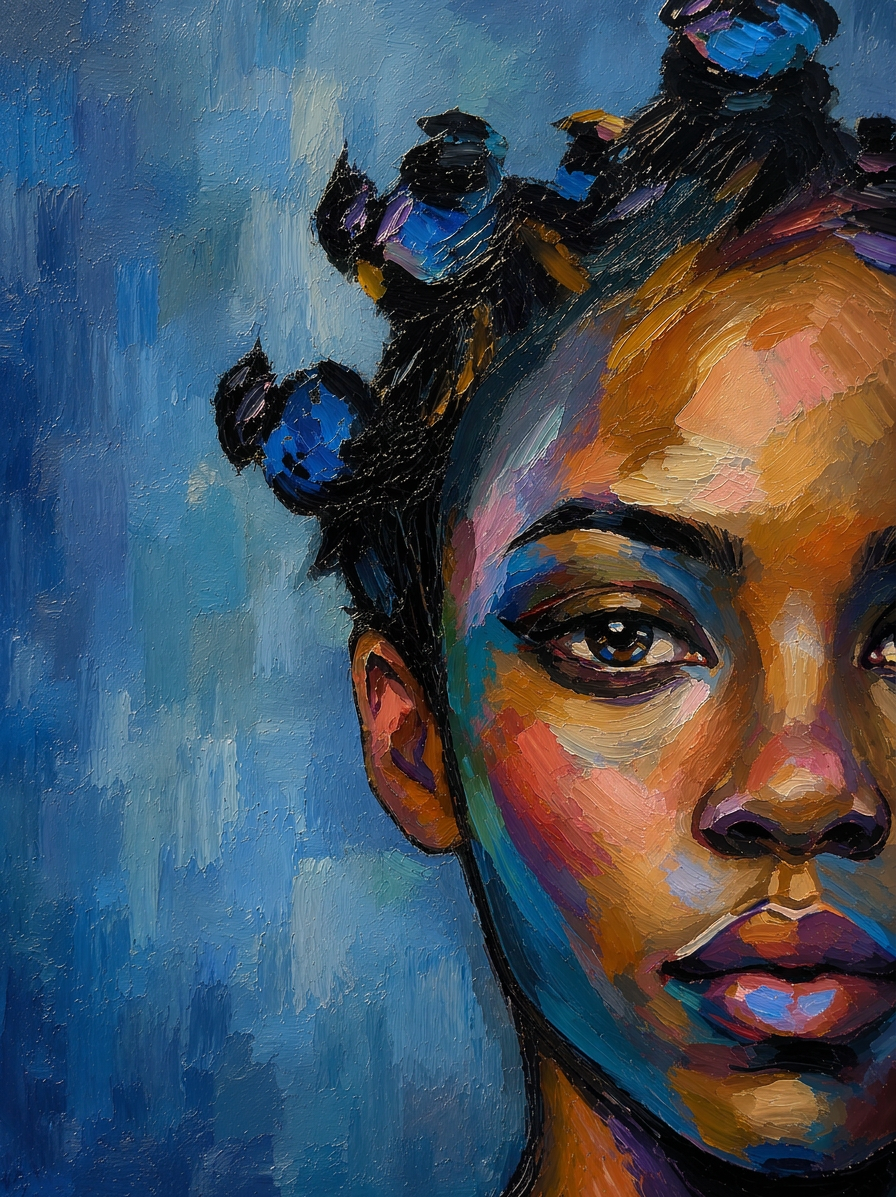
Becoming Her explores the journey of a young Black American woman searching for identity at the intersection of race, womanhood, history, culture, faith, and individuality.

She inherits stories that began long before her.

She carries the strength of women whose names she may never know. She belongs to a history marked by beauty and brilliance, but also by struggle, expectation, and survival. At the same time, she is growing up in a world constantly offering its own definitions of what a Black woman is supposed to look like, sound like, value, endure, and become.

Somewhere within all of those voices, she must discover her own.

Only part of her face fills the canvas, reflecting an identity that is still unfolding. Yet the portion we see is already overflowing with color.

Gold. Blue. Violet. Brown. Coral. Pink.

Each layer represents another piece of her becoming — her heritage, experiences, questions, dreams, contradictions, influences, wounds, faith, and possibilities.

There is no single color that defines her because there is no single story that can explain her.

Her Blackness is part of her.

Her American experience is part of her.

Her womanhood is part of her.

Her history is part of her.

But none of these alone can contain the entirety of who she is.

Her direct gaze suggests that she is beginning to look at the world for herself — questioning what she has inherited, what she has been taught, what others expect of her, and what she genuinely believes about herself.

And while she may still be discovering the woman she will become, Jeremiah 1:5 offers a beautiful counterpoint:

Before she knew herself, God knew her.

Before the labels.

Before the expectations.

Before the comparisons.

Before she ever questioned whether she was enough.

She was known.

Becoming Her is not a portrait of someone who has arrived.

It is a portrait of someone becoming.

I am learning my history without allowing history to limit my future.

I am discovering what Black womanhood means to me.

I am separating who the world expects me to be from who God created me to become.

I am honoring where I come from while discovering where I belong.

I do not have to have every answer yet.

I am still becoming her.

The Daughter’s Inheritance — Acrylic on canvas

The Daughter’s InheritanceAcrylic on canvas

Shop prints

The Daughter’s Inheritance

“We are God’s children. Now if we are children, then we are heirs—heirs of God and co-heirs with Christ.” — Romans 8:16–17

She does not need a crown for you to know she is royalty.

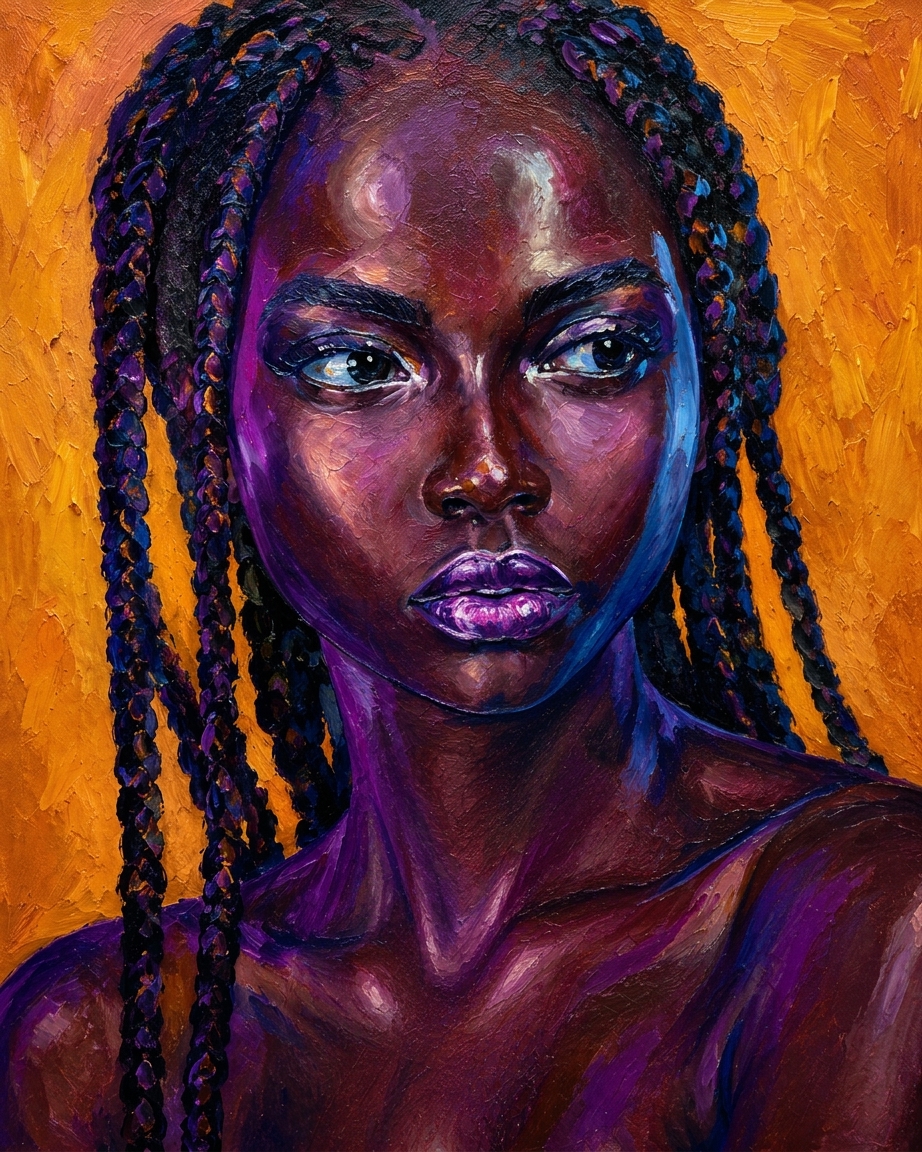
The Daughter’s Inheritance is a portrait of a Black woman resting in the majesty of knowing whose she is.

She is a daughter of the King of Kings.

And with daughterhood comes inheritance.

Her steady gaze carries the quiet confidence of a woman who understands that she does not have to earn her place in the Kingdom. She is not standing outside asking to be chosen. She is not striving to prove that she is worthy. She is not reaching for a crown.

She already belongs.

The deep purples woven throughout her skin evoke royalty, dignity, and spiritual authority, while the brilliant gold surrounding her becomes a visual representation of the inheritance into which she has been welcomed.

But her inheritance is not simply wealth or earthly abundance.

It is identity.

It is belonging.

It is purpose.

It is promise.

It is the assurance that she is loved by the Father and that her worth was established by Him long before the world had an opportunity to define her.

As a Black woman, she may live in a world that attempts to measure her value by her appearance, accomplishments, strength, productivity, or ability to endure.

But her Father calls her something greater:

Daughter.

Romans 8:16–17 reminds her that being a child of God also means being an heir. She has a place in His Kingdom. She has access to His promises. She carries an inheritance that cannot be taken away by rejection, circumstance, comparison, or the opinions of others.

There is nothing to prove when you know to whom you belong.

There is nothing to chase when you know what has already been promised.

There is a different kind of confidence that comes when a woman stops asking the world to tell her who she is and begins resting in what her Father has already spoken.

The Daughter’s Inheritance is her declaration:

My Father is the King of Kings.

I am not forgotten.

I am not overlooked.

I am not without purpose.

I am chosen.

I am loved.

I am His.

I carry dignity because I know whose daughter I am.

I walk in purpose because I know what I have inherited.

I am the daughter.

And I am resting in my inheritance.